

Brow Pre-Appointment Guide
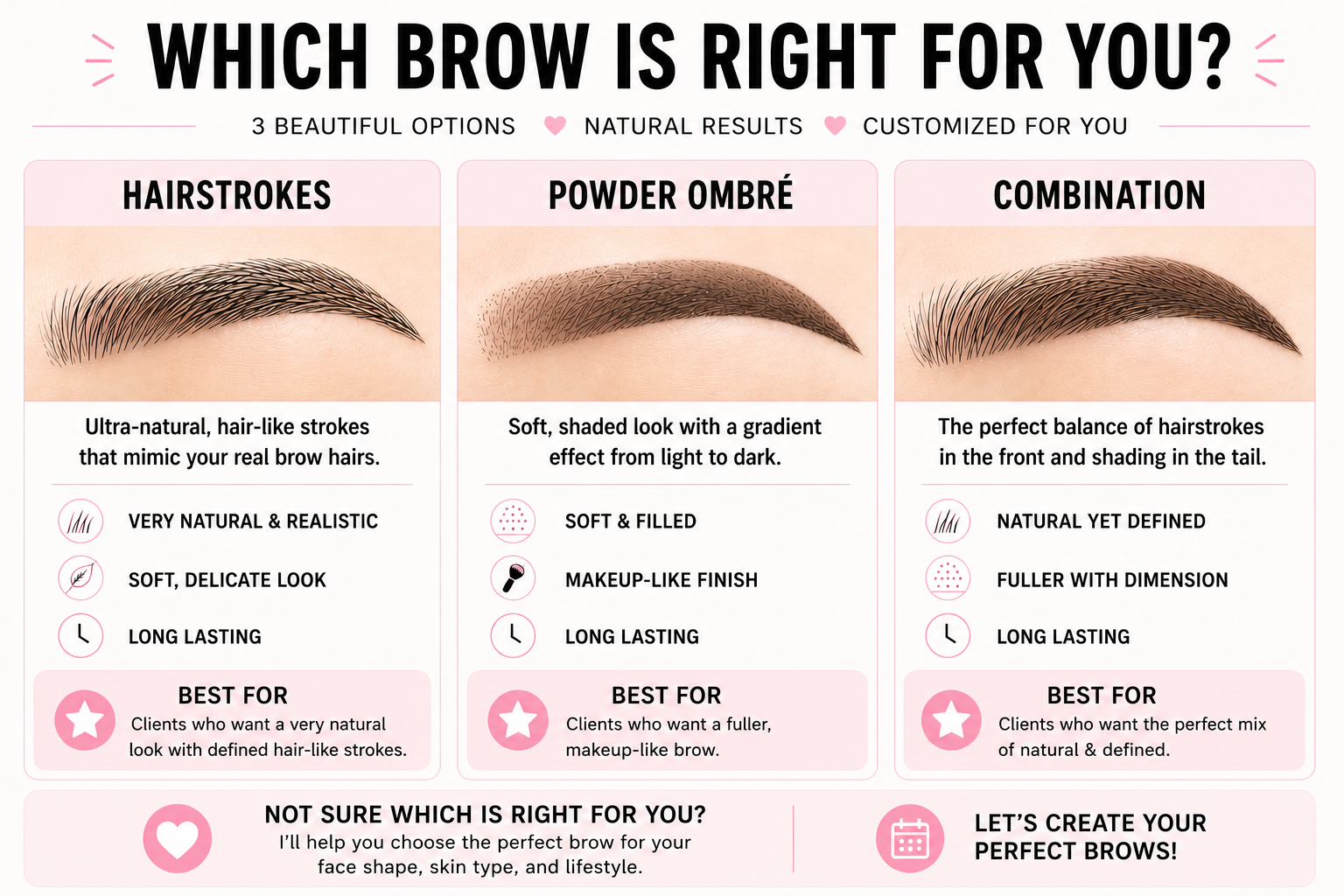
Before Microblading/Shading
The eyebrow area must be healthy, strong, non-sensitive, and non-irritated before your appointment. Please follow these guidelines to prepare your skin for the procedure:
Avoid before your appointment:
Do not tan or have a sunburned face for 2 weeks prior
Do not have any type of facial treatment for 2 weeks prior
Do not take Fish Oil or Vitamin E for 1 week prior, as they can thin the blood
To Avoid Excessive Bleeding and Poor Color Retention
Do not drink alcohol 24 hours before your appointment.
Avoid caffeine before your procedure.
Do not take Aspirin or Ibuprofen for pain relief - these medications thin the blood
The Following Treatments Are Not Recommended Within 30 Days of Your Procedure
Botox or fillers
Laser treatments
Chemical peels
Excessive sun exposure
After Microblading/Shading
Your brows will lighten approximately 20–30% during the healing process.
Results vary from person to person, so it is very important to follow the aftercare instructions and return for your touch-up appointment in 6–8 weeks.
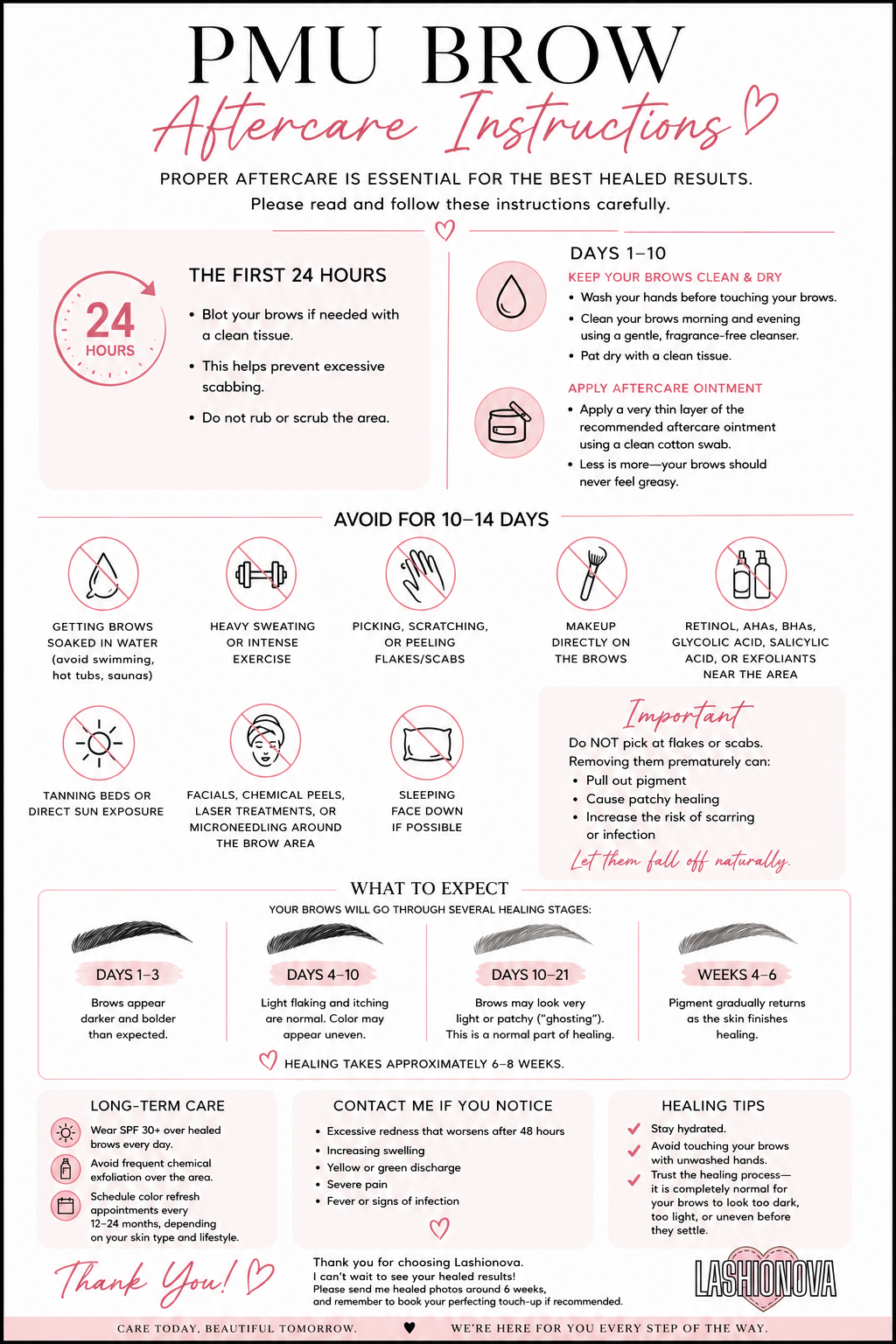
Keep your brows dry until all scabbing has naturally fallen off.
Aftercare Instructions
First 3 Days
If you notice any lymph fluid on the first day, gently pat it dry with a clean tissue
Apply the a paper-thin layer of the provided balm once per day using a gentle tapping motion
Next 7 Days (or Until Scabbing Is Complete)
Use a clean, fresh pillowcase.
Avoid exposing your brows to direct sunlight during healing. UV rays can alter the pigment color.
After the first 10 days, SPF protection is important for maintaining your results.
Avoid using cleansers, creams, or skincare products directly on the brows until flaking has stopped.
Wash around the area carefully using a cleansing cloth or makeup wipe.
Avoid activities that cause excessive sweating for at least 10 days. Sweat contains salt, which can interfere with healing and cause premature fading.
Avoid saunas, swimming pools, and steam rooms.
Do not apply Vaseline, makeup, creams, or exfoliants to the brows for at least 10 days.
Do not receive facials, massages, or skin treatments for at least 10 days.
Do not go tanning for at least 10 days.
After healing, always protect your brows from UV exposure to prevent pigment changes.
Avoid exfoliants, retinol products, and AHA acids on the brow area, as these can cause premature fading.
Avoid laser light therapy on the treated area, as it may darken, lighten, or distort the pigment.
Important Showering Instructions
Limit showers to 10 minutes to reduce steam exposure.
Keep your face out of the water while washing your body
Avoid excessive rinsing and hot water directly on the treated area.
Healing Process
The healing process is similar to that of a body tattoo. During healing, the eyebrow area will oxidize and gradually darken before softening to the final healed result.
The brows will appear darkest the day after the procedure.
Mild redness may occur and typically subsides within about 3 days.
Scabbing and flaking usually begin within 7–10 days.
Healing time varies from person to person. Some clients heal within 4 days, while others may take up to 2 weeks.
Avoid comparing your healing process to others, as every skin type heals differently.
Healing Timeline
Day 1–2
Brows may feel sore, sensitive, and appear dark.
Day 2–6
Brows become darker and thicker.
Day 7–10
Scabbing, itching, patchiness, and unevenness may occur.
Do not scratch or pick at your brows.
Day 11–15
Brows may appear too light or uneven.
Day 16–30
Color gradually reappears and softens into the healed result.
6 Weeks Later
Once the brows are fully healed, a touch-up appointment is required.
Touch-up appointments are typically scheduled within the first 3 months after the initial procedure. These appointments help perfect the shape, improve symmetry, and add density where needed.
Some clients may require multiple sessions to achieve their desired results.
Long-Term Maintenance
Maintenance appointments are recommended every 9–24 months, depending on:
Skin type
Lifestyle
Sun exposure
Skincare routine
Pigment retention
Please note that every skin type is different. Some clients may have more difficulty retaining pigment and may require additional sessions.